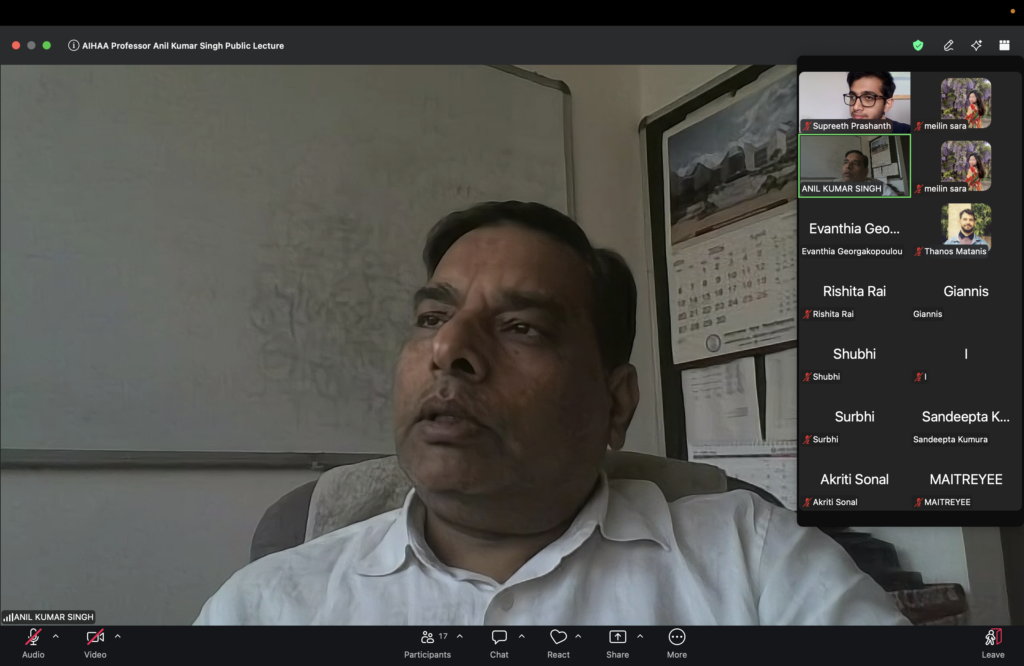
In April 2026, as part of an online lecture series attended by a group of approximately twenty engaged participants, Anil Kumar Singh from Jawaharlal Nehru University offered a thought-provoking exploration of the historical and intellectual connections between ancient India and Greece. The session was moderated by student Supreeth Prasanth, who fostered an intimate and interactive environment, allowing for both structured presentation and open discussion.
Professor Singh’s lectures traced possible points of contact and comparison between early Mediterranean and South Asian civilisations. In particular, he reflected on the cultural and symbolic dimensions of the Knossos and the Minoan civilization, considering how motifs, mythological structures, and patterns of exchange may resonate—directly or indirectly—with ancient Indian traditions.
A later discussion shifted toward the Byzantine Empire, opening a dialogue on the nature of connectivity between the Eastern Mediterranean and the Indian subcontinent in late antiquity and the medieval period. Participants reflected on trade networks, intellectual transmission, and religious encounters, raising questions about how Byzantine–Indian interactions might be understood within broader Eurasian dynamics.
Overall, the sessions highlighted the value of cross-cultural inquiry and interdisciplinary dialogue. By situating Greece and India within a shared, though complex, historical horizon, Professor Singh encouraged participants to rethink conventional geographic and civilisational boundaries and to approach ancient history through a more interconnected lens.